

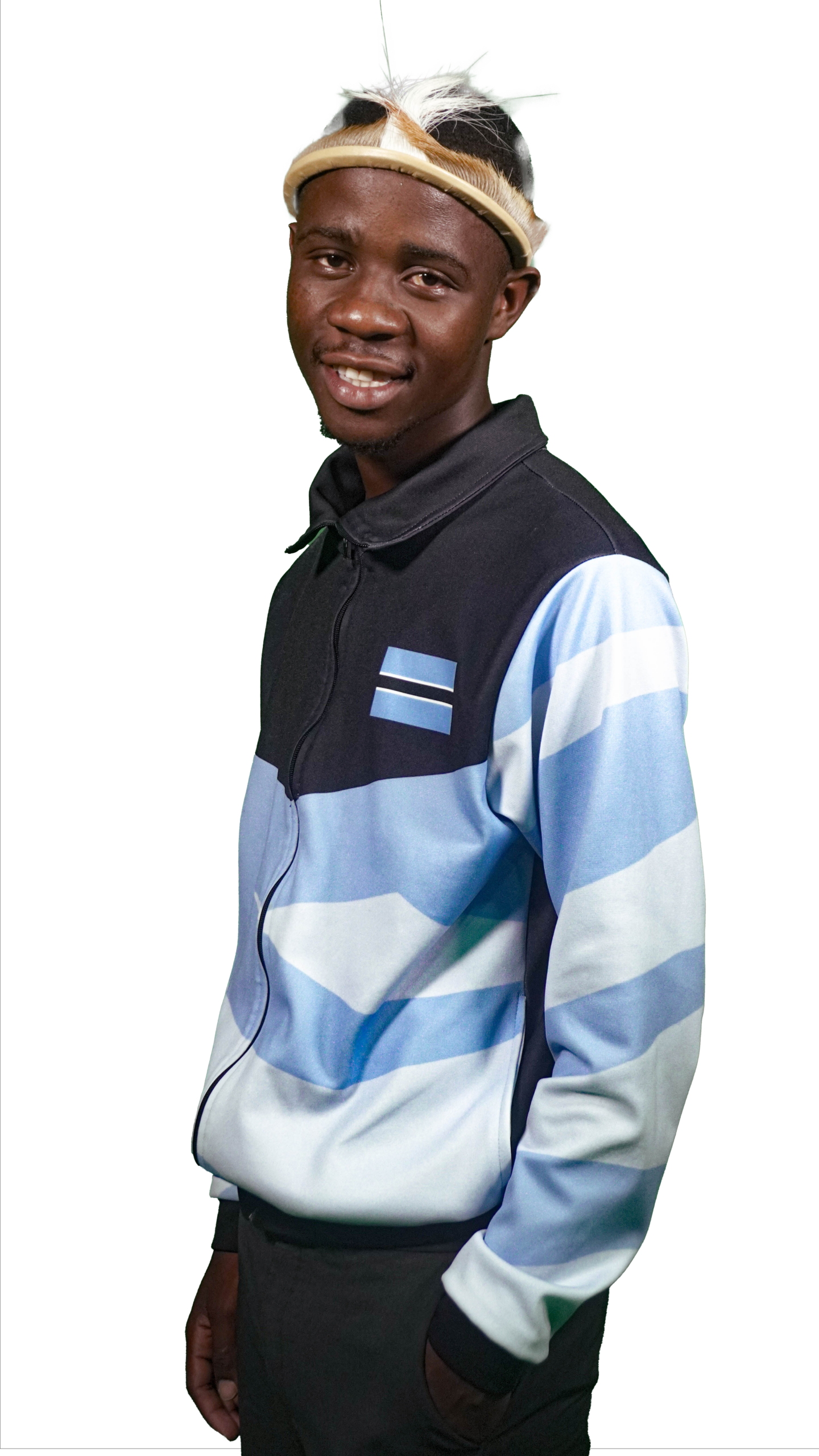
Thatayaone Lekoba is 22 years old, a brother of three, born in Kgomokasitwa village and shaped by the streets of Extension 16. His journey is not loud or rushed, it is intentional, reflective, and deeply rooted in culture. He is a poet by calling, not by convenience, and long before stages and microphones, he already knew who he was.
“I always believed I am a poet,” he says simply.
Raised in a family of creatives with a strong background in dikhwaere, traditional music, and dance, Thatayaone grew up surrounded by rhythm, harmony, and storytelling. Culture was never distant, it lived in his home, in his environment, in the voices of elders and the songs that filled the air. But as he grew older, a realization settled heavily on him: Tswana culture was slowly disappearing with each generation.
Rather than mourning its loss, he chose to preserve it.
Operating under the powerful slogan “Making Tswana Fashionable Again,” Thatayaone uses poetry as both resistance and remembrance. His work draws inspiration from traditional music, ancestral rhythms, and the raw energy of 90s and early 2000s South African Motswako. Every piece is a bridge, between past and present, village and city, memory and now.
Sometimes, when the poetic spirit feels fully present, he wears a tiara and walks onto the stage barefooted. It is not performance for shock value, it is ritual. Grounding. Honouring something older than himself.
Poetry, he says, visits him unexpectedly. Lines arrive anywhere, anytime, often uninvited. Yet before a performance, discipline takes over. He clears his mind and listens to music, not to inspire new ideas, but to silence them. New lines at the wrong time could disrupt the carefully prepared piece.
Anxiety follows him right up until he steps behind the microphone. Then it disappears.
“Once I stand there, it all goes away,” he says. What remains is connection. He performs with intention, making sure his audience understands every detail, even when his poetry is deeply figurative. He does not speak to people, he speaks with them.
Every achievement matters to him. Choosing a single highlight feels impossible because the journey itself carries weight. From pre-school, where his passion was first discovered, to now, poetry has never left him. Talent opened the door, timing played its part, but persistence kept him standing.
Still, Thatayaone is often misunderstood. Many assume he and AuthorBlack are the same person. He disagrees.
“Yes, they are one, but not really.”
AuthorBlack is the performer, the voice, the fire. Thatayaone is private, reserved, and introspective. His poetry can be intimate, even vulnerable, yet he is not comfortable having intimate conversations about it afterward. That contrast surprises people most: how someone can recite something so personal and then retreat into silence. But that boundary is intentional, it protects the artist.
Poetry is his everyday therapy. He does not have many friends, so he shares his thoughts with paper. He rarely writes about himself because he wants audiences to know AuthorBlack, not Thatayaone. Once, he wrote a political poem, one he has never performed to this day. Some words, he believes, are not ready for the world.
His inspiration reaches back to childhood bonfire memories, when his great-grandmother told mainane, Diane, and dithamalakane, stories about culture, origins, and identity. When asked what symbol represents him best, he chooses fire.
“The way it lights up a room,” he says.
There were moments he nearly quit. Exhaustion took its toll. Doubt crept in. But a friend spoke sense into his ear, and he returned with renewed focus. The answer was simple, though not easy: more rehearsal, and then even more rehearsal.
Thatayaone speaks candidly about poetry’s place in society. He believes it is the most crucial art form for delivering real messages, yet also the most overlooked. While social media has created opportunities, institutional support remains lacking. Still, platforms and individuals like Angel of Poetry, Kago Africa, Motlatsi, and Phenyo continue to carry the movement forward.
Five years ago, he was performing mainly in English. Then he made a defining shift, to Setswana. Not just a change of language, but a cultural statement. He embraced an unconventional Setswana poetic style, one that was once questioned and is now celebrated. Today, it is in vogue, and he feels firmly in his becoming era, aware that growth is still unfolding.
Fear still exists. His greatest fear is messing up a piece on stage. During difficult moments, he returns to his upbringing, everything he was taught about composure, strength, and acceptance. Balance, he says, has always come naturally, perhaps because he is multi-talented and disciplined with time.
Beyond poetry, he dreams of building something tangible, an entity he can truly call his own, starting with graphics. The AuthorBlack brand, he believes, did not happen by chance. It was built through trials, patience, and unwavering belief. He also hopes to return to school someday, still holding onto the dream of becoming a student again.
Love remains unexplored territory. He has not really tried, or perhaps luck has not yet found him. What he does have are affirmations from strangers who say he reminds them of great poets who came before, some whose names he has never even heard. That recognition humbles him deeply.
If he could speak to his younger self, his message would be clear and steady:
“Focus.”
Because Thatayaone Lekoba is not only preserving culture, he is proof that it can evolve, speak boldly, walk barefoot into modern spaces, and still carry the weight of ancestry.
AuthorBlack is not just a poet.
He is a quiet fire.
 Administrator